
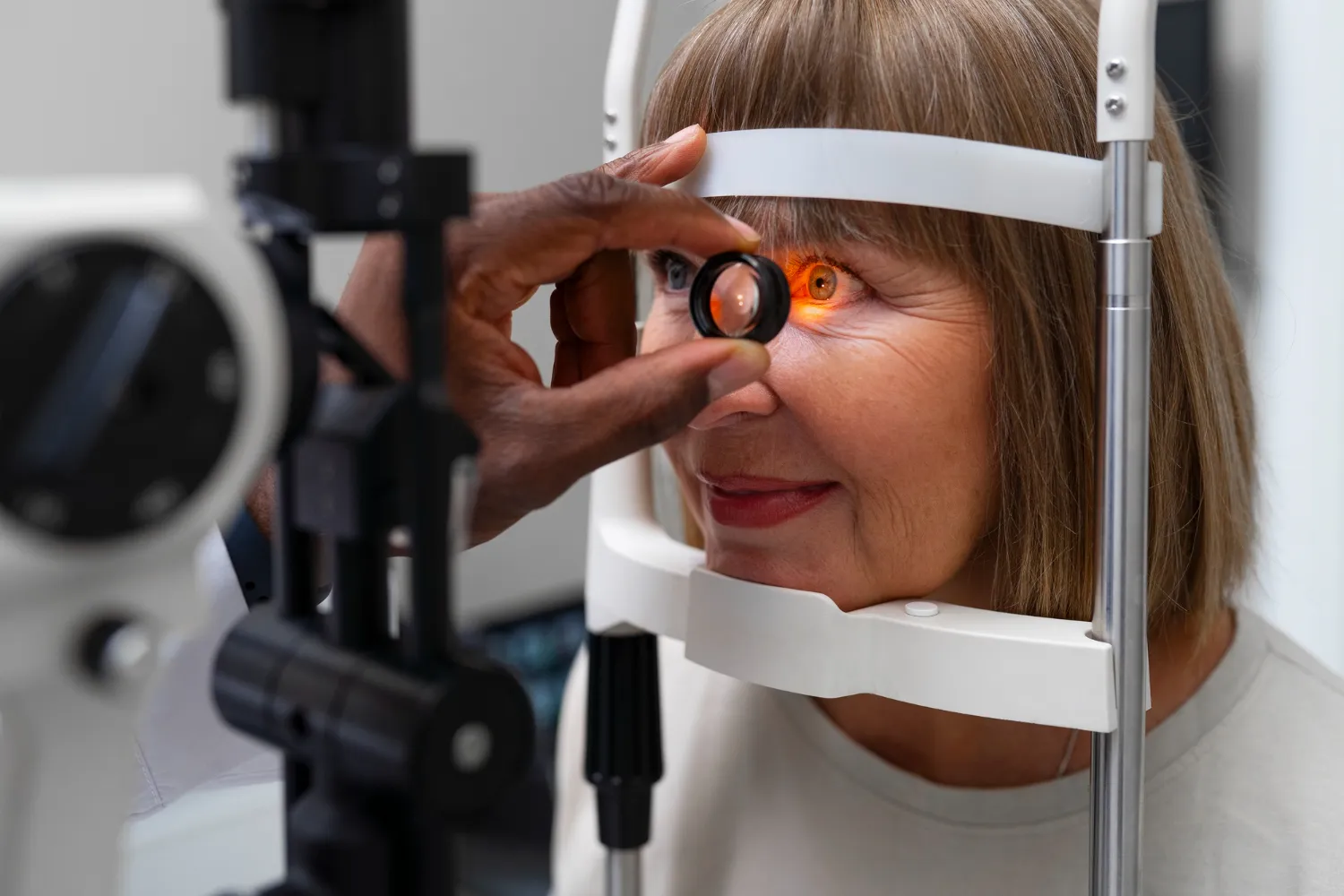
Preserve your central vision from AMD
Age-related Macular Degeneration Treatment
Early detection and modern treatments can slow AMD progression, helping you maintain reading, driving and sharp central vision for longer.
- Affects the macula (central retina) responsible for sharp, detailed vision
- Dry AMD (90% cases): slow thinning of retinal layers
- Wet AMD (10% cases): abnormal blood vessels leak under the retina

Know the early warning signs
Who should get checked for AMD?
- Wavy or distorted central vision (straight lines look bent)
- Central blind spot or blurry patch when reading or recognising faces
- Colours appearing less vivid or difficulty adapting to low light
- Risk factors: Age 50+, family history, smoking, high blood pressure
AMD usually develops gradually after age 50, but risk factors and family history can make it appear earlier. Get an AMD check if you notice:
What is involved in AMD Treatment?
Slowing progression, protecting vision
AMD treatment focuses on slowing disease progression and preventing further central vision loss. Dry AMD uses nutritional supplements; wet AMD requires injections to block/”close-up” abnormal vessel growth.
-
AMD diagnosis
OCT scan, fundus photography, Amsler grid test
-
Treatment plan
AREDS2 vitamins (dry), anti‑VEGF injections (wet)
-
Monitoring
Monthly OCT scans initially to track response, lifestyle modifications.

Treatment approaches for dry and wet AMD
Options depend on AMD type
Management differs for dry (early and intermediate) and wet (neovascular) age-related macular degeneration. An eye examination helps determine which approach is appropriate for each patient’s stage and type of AMD.
Your Recovery
Ongoing Care to Protect Your Central Vision
Treatment for Age-related Macular Degeneration (AMD) focuses on slowing disease progression and preserving central vision. Recovery is usually gradual and requires regular monitoring.
The Treatment Day
Injections or laser treatments are performed as outpatient procedures, and most patients can return home shortly after with only mild temporary eye irritation or watering.
The First Few Days
Mild redness or blurred vision may occur temporarily; avoid rubbing the eye, use prescribed eye drops as instructed, and contact the clinic if pain increases or vision changes suddenly.
Ongoing Monitoring
AMD requires regular follow-up to monitor treatment response, and additional injections or sessions may be recommended to help protect your remaining vision over time.
Patient voices
4.9 Stars on Google.
Real stories from the thousands of patients who have trusted us with their sight.
“Dr Huang literally saved my eyesight. After 3 doctors misdiagnosed my severe eye infection in Bali and things were getting worse, I booked a flight to Singapore and set an appointment with Dr Huang. Within 5 minutes of sitting down, he already correctly diagnosed my rare condition and began laying out my treatment plan.”

“One of the best decisions I’ve made! Dr Phi answered all my doubts and worries, and made sure that I’m assured on the procedure process and kindly explain to me every step that is he doing during the procedure itself, which is something I’m so appreciative for!”

“I’d like to thank Dr. Huang for being such a wonderful doctor through my process of getting perfect vision. He was so assuring and put me at ease throughout every step of the way, and conducted my procedure with utmost professionalism and expertise. Post-surgery care was also very well conducted; any concerns I had were addressed and allayed. Thank you so much for the great experience amidst what was initially a scary thing for me.”

I recently had TransPRK procedure done by Dr. Philemon and couldn’t have asked for a better experience. From the very first consultation, he took the time to explain every step in detail, making sure I understood what to expect. He’s very thorough and meticulous. You can tell he cares about his patients and takes pride in doing everything perfectly.
What stood out most was how genuine and attentive he is. He checked in with me before and after the procedure, made sure all my questions were answered, and went above and beyond to make sure I felt cared for.
It’s rare to find someone who’s both exceptionally professional and sincerely compassionate. I sincerely recommend Dr. Philemon to anyone considering refractive surgery.

I’m incredibly grateful to Dr Philemon Huang for the outstanding care and results he delivered. I underwent IOL implant surgery with Dr Huang, and it completely transformed my vision—from being unable to see without glasses to achieving 20/20 vision after surgery.
Dr Huang was clear, professional, and thorough in his recommendations, explaining why LASIK wasn’t suitable for me and why the IOL approach was the best option. His expertise and confidence made the entire process feel reassuring, and the results speak for themselves.
Thank you, Dr Philemon Huang, for your exceptional skill and care. I couldn’t be happier with the outcome.

Clarifying Your Concerns
Frequently Asked Questions
We understand that eye-related conditions and treatments can feel daunting. Here are honest, transparent answers to the questions we hear most often from patients and their families
AMD is a condition that affects the macula, the central part of the retina responsible for sharp, detailed vision. It mainly affects people over 50 and can impact reading and recognising faces.
Currently, there is no cure for AMD. However, treatment can slow progression and help preserve vision, especially in wet AMD.
Dry AMD is usually monitored regularly. In certain stages, specific nutritional supplements may be recommended to reduce the risk of progression.
Wet AMD is commonly treated with anti-VEGF eye injections. These medications help reduce abnormal blood vessel growth and leakage in the retina.
The eye is numbed before the procedure. Most patients experience mild discomfort or pressure rather than pain. The procedure is typically quick and done in clinic.
Yes. Medisave may be used for certain treatments for Age-related Macular Degeneration (AMD), subject to Ministry of Health (MOH) guidelines and withdrawal limits. Our team will advise you on eligibility and claimable amounts during your consultation.
While there is no cure, the latest 2026 protocols include AREDS2 antioxidant supplements and newly approved Photobiomodulation (PBM) light therapy, which can help slow progression and reduce drusen size in some patients.