

Laser-Integrated Surgical Procedures
Femtosecond Laser-Assisted Cataract Surgery (FLACS)
FLACS uses femtosecond laser technology for greater precision in creating corneal incisions, opening the lens capsule, and sectioning the cataract. This technique may offer enhanced accuracy for certain eye profiles. Suitability is determined through detailed pre‑operative imaging and assessment.
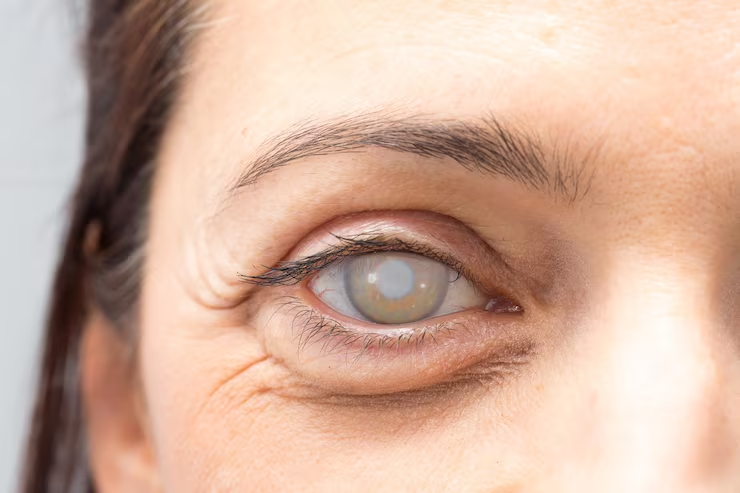
Why Choose Femtosecond Laser-Assisted Cataract Surgery (FLACS)
A safer, smarter path to clarity.
FLACS uses a precision laser to assist cataract removal, offering accuracy and safety tailored to each patient. Here’s why it may be suitable:
- Laser Precision
The femtosecond laser creates exact incisions and fragments the lens. - Minimally Invasive
Small, laser-guided cuts reduce trauma to the eye, supporting healing and recovery. - Supports Everyday Activities
Gentle, controlled laser steps help patients return to daily life sooner compared to traditional extracapsular technique.
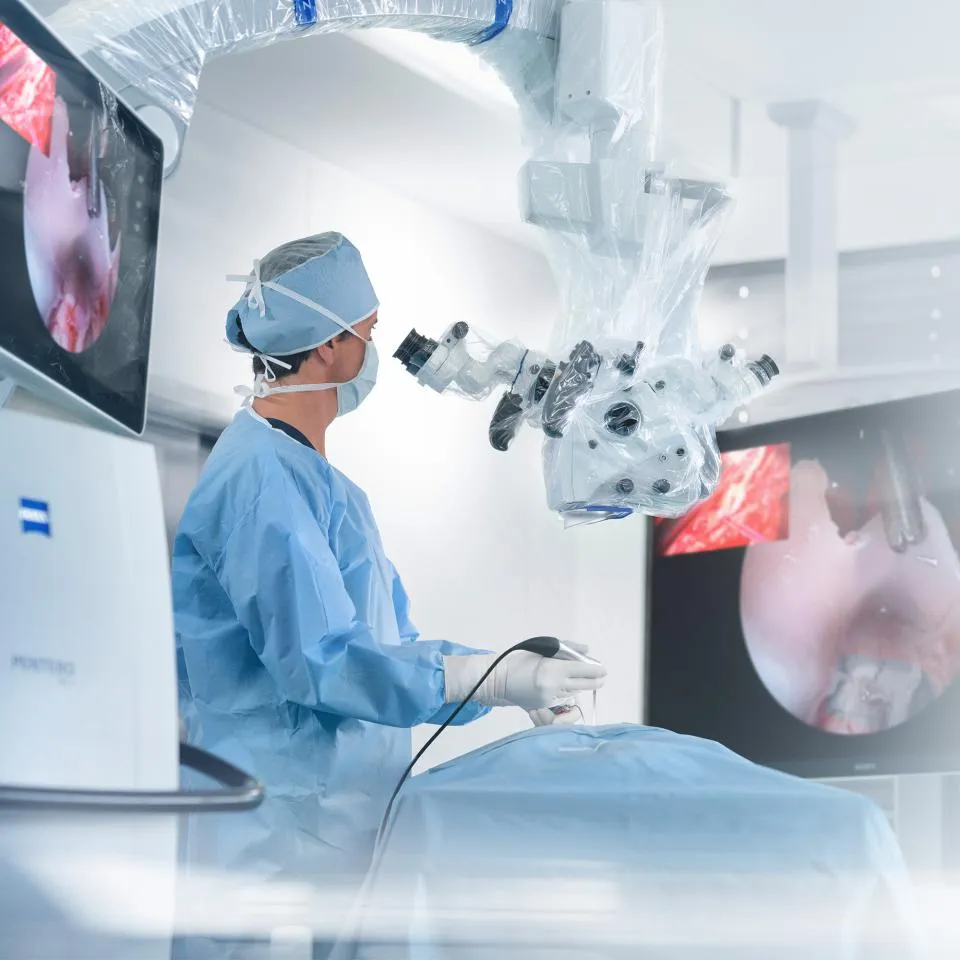
Candidate Checklist
Who may benefit from FLACS
- Are over 50 and have significant cataract-related vision problems.
- Experience difficulty with daily activities such as reading, driving, or seeing at night due to cataracts.
- Are looking for a more precise cataract surgery with a quicker recovery time.
- Have healthy eyes with no underlying glaucoma or advanced eye disease.
FLACS may be recommended for patients seeking greater precision, those with corneal conditions, or complex lens anatomy. It’s ideal when precise incision placement and capsule opening are needed. A thorough evaluation with corneal topography and OCT helps determine if FLACS is better than standard phacoemulsification.
FLACS is suitable for most individuals with cataracts, particularly those who:
FLACS is suitable for most individuals with cataracts, particularly those who:
Choosing the right option for your vision
Comparing Cataract Surgery Methods
Phacoemulsification (Phaco), Femtosecond Laser-Assisted Cataract Surgery (FLACS), and Extracapsular Cataract Extraction (ECCE) are established methods used to treat cataracts. An eye examination will determine which option is suitable for your condition.
| Feature | Phacoemulsification (Phaco) |
Femtosecond Laser-Assisted (FLACS) |
Extracapsular Extraction (ECCE) |
|---|---|---|---|
| Description | Ultrasound to emulsify and aspirate lens through small incision | Laser for capsulotomy and fragmentation; then phaco | Manual removal of lens nucleus intact through larger incision |
| Incision Size | 2–3 mm | 2–3 mm | 10–12 mm |
| Anesthesia | Topical / Local | Topical / Local | Local, sometimes sedation |
| Procedure Time | 15–30 minutes | Slightly longer due to laser step | 30–60 minutes |
| Recovery Time | 1–2 days for daily tasks; full vision 1–4 weeks | Similar to Phaco: 1–2 days | 1–2 weeks or more; sutures needed |
| Cost (per eye, approx. SGD incl. GST) | From $4,905 | From $4,905 (varies with laser) | From $4,905 |
| Best For | Most cataracts, routine cases | Complex cases, premium IOLs, low endothelial count | Very dense / hard cataracts, zonular weakness |
| Key Advantages | Minimally invasive, fast recovery, low astigmatism risk, high success rate (~90%) | Precise capsulotomy, lower phaco energy, less endothelial loss in some cases | Effective for extreme dense cataracts, no ultrasound damage |
| Key Disadvantages | May struggle with very dense cataracts; risks like PCO, IOP fluctuations | High cost, IOP rise during docking, pupil constriction, not superior overall | Larger incision, slower recovery, higher astigmatism / infection risk |
The FLACS Procedure: 3 Simple Steps
What to ExpectFrom start to finish, you will be in the surgical suite for just a few minutes. Here is exactly what happens during your painless procedure.
Laser Mapping
A high-definition scan maps your eye’s unique anatomy. The laser then creates a perfect, blade-free opening with microscopic precision.
Gentle Removal
Surgeon removes broken-up cataract using minimal ultrasound energy through tiny incision.
IOL Placement
Your custom intraocular lens (IOL) is precisely positioned to restore your sight. The tiny opening heals naturally without any stitches.
Your Recovery
What to expect during your recovery
FLACS is a precise, minimally invasive procedure with a fast recovery. Most patients notice improved vision within days, with full healing in a few weeks.
The Procedure
The surgery takes around 15-30 minutes with local anaesthesia. You may experience mild discomfort and blurry vision post-surgery.
The Next Day
Mild redness and light sensitivity may persist. Vision may fluctuate, and you’ll be given eye drops to prevent infection and reduce inflammation.
Full Recovery
Most patients experience significant improvement within a few days, with full recovery in 4-6 weeks. You can return to regular activities once cleared by your doctor.
Clarifying Your Concerns
frequently asked questions
We understand that eye surgery—especially for seniors—can feel daunting. Here are honest, transparent answers to the questions we hear most often from patients and their families
FLACS is an advanced cataract surgery that uses a femtosecond laser to perform key steps of the procedure with high precision. The laser is used to make incisions, break up the cataract, and soften the lens before it is removed, all without the need for blades.
While traditional cataract surgery uses manual methods, FLACS employs a laser to perform specific tasks like making incisions, creating capsulotomies, and fragmenting the cataract. This offers greater precision in some scenario, potentially leading to improved visual outcomes and faster recovery.
Depends. In certain scenario, FLACS provides more precision, which can reduce the risk of complications. The laser’s accuracy can lead to smaller incisions, less trauma to the eye, and a more predictable outcome, contributing to a safer procedure compared to manual methods.
The femtosecond laser uses quick, focused light pulses to make precise cuts in the eye. It creates the opening in the lens capsule (capsulotomy), breaks up the cataract into smaller pieces, and makes incisions in the cornea with minimal impact on surrounding tissue.
FLACS is performed under local anaesthesia, so you won’t feel any pain during the procedure. Some patients may experience mild pressure or discomfort, but the procedure is generally well-tolerated and quick.
Femtosecond laser-assisted cataract surgery usually takes about 15 to 30 minutes, depending on the complexity of the case. Most patients are able to go home the same day.
The key benefits of FLACS include:
-
Enhanced precision and control for better surgical outcomes
-
Smaller, more accurate incisions leading to faster healing
-
A more predictable surgical result, especially for complex cataracts
-
Reduced risk of complications, such as astigmatism or posterior capsule rupture
Recovery after FLACS is generally quick. Most patients notice an improvement in vision within a few days, although complete recovery may take a few weeks. You’ll need to attend follow-up appointments to ensure proper healing.
FLACS is a safe procedure, but like any surgery, it carries risks such as infection, bleeding, or changes in intraocular pressure. Your ophthalmologist will discuss the risks and ensure that FLACS is appropriate for your condition.
Depending on the type of intraocular lens (IOL) you receive, you may still need glasses for reading or distance. Some patients opt for multifocal or accommodating IOLs to reduce their dependence on glasses after surgery.