

Small‑incision cataract surgery
Phacoemulsification (Phaco)
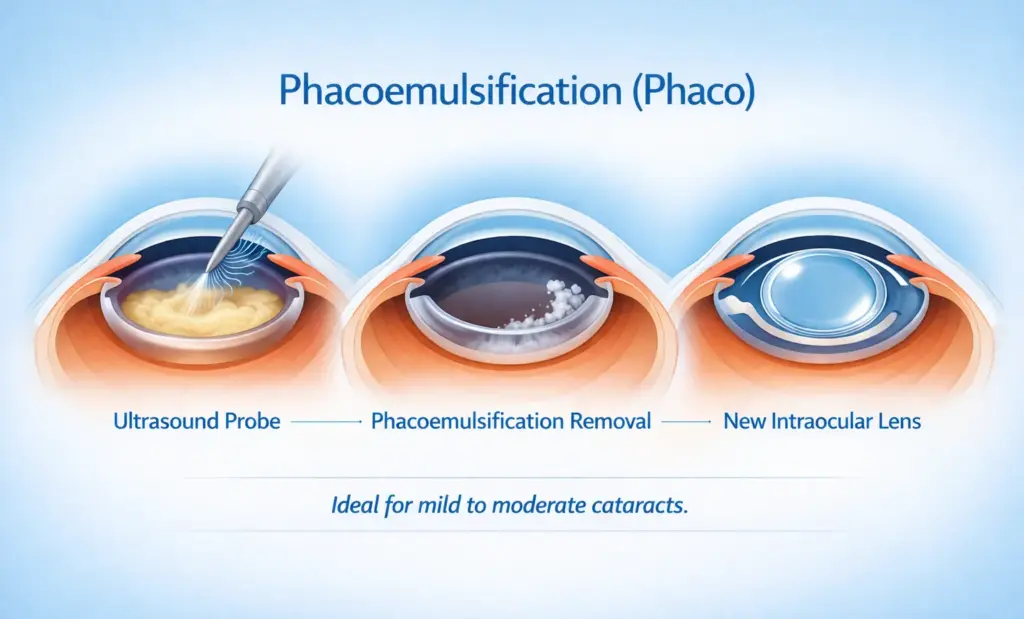
Phacoemulsification is a modern cataract surgery technique that removes the cloudy lens through a small incision and replaces it with a clear artificial lens. The procedure is usually done as day surgery under local anaesthesia with optional sedation to maximize comfort for patients. A detailed pre‑surgery evaluation helps determine if this approach is suitable for your eyes and lifestyle.
Why Choose Phacoemulsification (Phaco)?
Phacoemulsification (Phaco) Advantage
Phacoemulsification is a minimally invasive cataract surgery that uses ultrasound to gently break up the cloudy lens. Here’s why it is often recommended:
- Small Incision, Faster Recovery
The procedure uses a tiny incision, reducing healing time and lowering the risk of complications. - Preserves Eye Structure
By avoiding large cuts, Phaco maintains the integrity of the cornea and surrounding tissues. - Precise Lens Replacement
The cataract is removed carefully and replaced with an intraocular lens (IOL) to restore vision clarity. - Suitable for Daily Activities
The gentle approach allows most patients to return to normal routines quickly, supporting everyday visual needs.

Candidate Checklist
Who should do Phacoemulsification (Phaco)?
- Blurred vision affecting daily tasks
- Glare and haloes from lights
- Difficulty reading or need to keep changing glasses degree
- Affecting activities of daily living
We recommend surgery when cataracts impact daily tasks like driving or reading. A comprehensive exam will determine if a small-incision phaco technique is the best fit for your unique eye health.
You may benefit from Phacoemulsification if you notice:
You may benefit from Phacoemulsification if you notice:
Choosing the right option for your vision
Comparing Cataract Surgery Methods
Phacoemulsification (Phaco), Femtosecond Laser-Assisted Cataract Surgery (FLACS), and Extracapsular Cataract Extraction (ECCE) are established methods used to treat cataracts. An eye examination will determine which option is suitable for your condition.
| Feature | Phacoemulsification (Phaco) |
Femtosecond Laser-Assisted (FLACS) |
Extracapsular Extraction (ECCE) |
|---|---|---|---|
| Description | Ultrasound to emulsify and aspirate lens through small incision | Laser for capsulotomy and fragmentation; then phaco | Manual removal of lens nucleus intact through larger incision |
| Incision Size | 2–3 mm | 2–3 mm | 10–12 mm |
| Anesthesia | Topical / Local | Topical / Local | Local, sometimes sedation |
| Procedure Time | 15–30 minutes | Slightly longer due to laser step | 30–60 minutes |
| Recovery Time | 1–2 days for daily tasks; full vision 1–4 weeks | Similar to Phaco: 1–2 days | 1–2 weeks or more; sutures needed |
| Cost (per eye, approx. SGD incl. GST) | From $4,905 | From $4,905 (varies with laser) | From $4,905 |
| Best For | Most cataracts, routine cases | Complex cases, premium IOLs, low endothelial count | Very dense / hard cataracts, zonular weakness |
| Key Advantages | Minimally invasive, fast recovery, low astigmatism risk, high success rate (~90%) | Precise capsulotomy, lower phaco energy, less endothelial loss in some cases | Effective for extreme dense cataracts, no ultrasound damage |
| Key Disadvantages | May struggle with very dense cataracts; risks like PCO, IOP fluctuations | High cost, IOP rise during docking, pupil constriction, not superior overall | Larger incision, slower recovery, higher astigmatism / infection risk |
The Phacoemulsification (Phaco) Procedure: 3 Simple Steps
What to expectFrom start to finish, you will be in the surgical suite for just a few minutes. Here is exactly what happens during your painless procedure.
Small Incision
A tiny incision is made in the cornea, allowing gentle access to the cloudy lens.
Lens Removal
Ultrasound energy breaks up the cataract, which is then carefully removed from the eye.
Intraocular Lens Implant
A clear intraocular lens (IOL) is inserted, restoring vision and clarity with minimal disruption.
Your Recovery
What to expect during your recovery
Phacoemulsification is a minimally invasive cataract surgery with a quick recovery time. Most patients experience significant improvements within a few days, but complete healing takes several weeks.
The Procedure
The surgery takes 15-30 minutes under local anaesthesia. Expect mild irritation and blurry vision afterward.
The Next Day
Mild redness or sensitivity may persist, but discomfort should reduce. Vision may fluctuate, and eye drops will help prevent infection.
Full Recovery
Full recovery typically occurs within 4-6 weeks. Vision improves steadily, and you can resume most activities once cleared by your doctor.
Clarifying Your Concerns
frequently asked questions
We understand that eye surgery—especially for seniors—can feel daunting. Here are honest, transparent answers to the questions we hear most often from patients and their families
Phacoemulsification is a minimally invasive cataract surgery technique that uses ultrasound waves to break up the cloudy lens (cataract) into small pieces, which are then gently suctioned out. A new, clear artificial lens (IOL) is placed in its place.
Unlike traditional methods, phacoemulsification requires a smaller incision, which reduces the risk of complications and promotes faster healing. It is also more precise, requiring less time to remove the cataract.
Yes, phacoemulsification is a highly safe and effective procedure. It is the most commonly performed cataract surgery worldwide with a very low risk of complications. Your surgeon will assess your specific case to ensure it’s suitable for this technique.
The procedure is performed under local anaesthesia, which numbs the eye. Sedation can be provided to make the procedure less stressful. The surgeon makes a tiny incision in the cornea, inserts a probe that emits ultrasound waves to break up the cataract, and then removes the pieces. The new lens implant is then positioned in place.
Phacoemulsification surgery usually takes around 15 to 30 minutes. It is performed as an outpatient procedure, meaning you can go home the same day.
Most patients experience a relatively quick recovery. You can expect some mild discomfort, blurry vision, or redness for a few days. Vision typically improves within a few days to weeks. Full recovery and stabilization of vision may take up to a month.
While phacoemulsification is safe, like any surgery, it carries some risks, such as infection, bleeding, retinal detachment, or increased eye pressure. Your ophthalmologist will provide detailed information and preventive measures.
You may still need glasses for reading or distance vision, depending on the type of intraocular lens (IOL) implanted. Some patients opt for multifocal or accommodating lenses to reduce the need for glasses after surgery.
Your ophthalmologist will provide specific pre-operative instructions. This may include fasting for a few hours before the procedure and using prescribed eye drops to prepare the eye. Be sure to arrange for someone to drive you home after surgery.
While many patients notice improved vision shortly after surgery, it may take a few days for vision to fully stabilize. Some blurriness or sensitivity to light is common in the first few days.