
Restoring Vision, Preserving Aesthetics.
Orbit, Lacrimal & Socket Issues Treatment
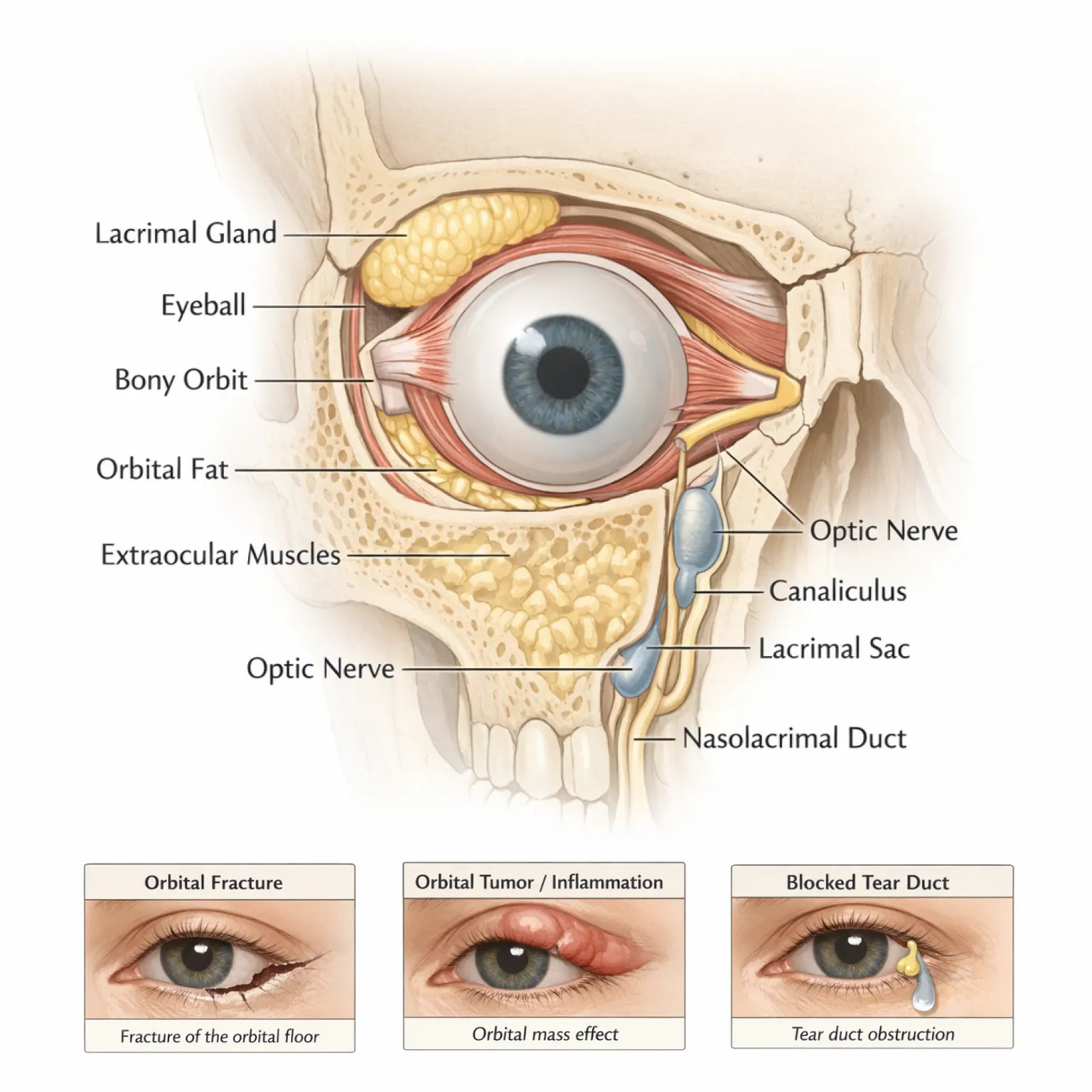
Orbit, lacrimal and eye socket conditions affect the structures around the eye rather than the eyeball itself. Treatment focuses on protecting vision, relieving symptoms and restoring a natural appearance.
Common signs needing attention
Who should get checked?
- Bulging, sunken or visibly displaced eye
- Persistent eyelid or socket swelling, pain or redness
- New double vision or restricted eye movements
- Constant tearing, discharge or recurrent tear‑duct infections
- Loss of an eye requiring an artificial (prosthetic) eye and socket care
An assessment is recommended if you notice new or persistent changes around one or both eyes.
Common reasons to see a specialist include:
What is involved in Orbit, Lacrimal & Socket Issues Treatment?
Thorough evaluation of the tissues around the eye
Assessment involves a comprehensive examination of the eye and surrounding structures.
Typical steps:
- Clinical examination – eyelids, tear drainage openings, eye movements and eye position are checked.
- Imaging when needed – scans such as CT or MRI are arranged if deeper socket or sinus problems are suspected.
- Joined‑up care – the eye specialist may work with ENT, endocrinology or oncology colleagues, depending on the cause.
The treatment plan is then tailored to the specific diagnosis and whether the problem is mainly functional, cosmetic, or both.

Types of Treatment
From medications to reconstructive surgery
Treatment varies from medication to surgery, depending on the condition. Options range from managing inflammation to reconstructing the orbital area, all aimed at restoring function and appearance.
Smooth recovery timeline
What to expect during recovery
Recovery depends on the specific treatment received. Some procedures may offer quick relief, while others require a more gradual healing process. Follow your doctor's instructions for the best results.
Immediately After Treatment
You may experience swelling, discomfort, or mild bruising, particularly after surgery. If you had injections or procedures, your doctor may recommend ice packs and prescribed medications to manage symptoms.
The First Few Days to Weeks
For procedures like orbital decompression or tear-duct surgery, swelling and bruising may persist for several days. You may also experience some drainage or mild irritation. Continue following prescribed aftercare and attend follow-up visits.
Full Recovery
Most treatments show significant improvement within a few weeks. For surgeries like socket reconstruction, it may take longer for the final results to become visible. Ongoing care may include prosthetic eye adjustments or socket health checks.
Patient voices
4.9 Stars on Google.
Real stories from the thousands of patients who have trusted us with their sight.
“Dr Huang literally saved my eyesight. After 3 doctors misdiagnosed my severe eye infection in Bali and things were getting worse, I booked a flight to Singapore and set an appointment with Dr Huang. Within 5 minutes of sitting down, he already correctly diagnosed my rare condition and began laying out my treatment plan.”

“One of the best decisions I’ve made! Dr Phi answered all my doubts and worries, and made sure that I’m assured on the procedure process and kindly explain to me every step that is he doing during the procedure itself, which is something I’m so appreciative for!”

“I’d like to thank Dr. Huang for being such a wonderful doctor through my process of getting perfect vision. He was so assuring and put me at ease throughout every step of the way, and conducted my procedure with utmost professionalism and expertise. Post-surgery care was also very well conducted; any concerns I had were addressed and allayed. Thank you so much for the great experience amidst what was initially a scary thing for me.”

I recently had TransPRK procedure done by Dr. Philemon and couldn’t have asked for a better experience. From the very first consultation, he took the time to explain every step in detail, making sure I understood what to expect. He’s very thorough and meticulous. You can tell he cares about his patients and takes pride in doing everything perfectly.
What stood out most was how genuine and attentive he is. He checked in with me before and after the procedure, made sure all my questions were answered, and went above and beyond to make sure I felt cared for.
It’s rare to find someone who’s both exceptionally professional and sincerely compassionate. I sincerely recommend Dr. Philemon to anyone considering refractive surgery.

I’m incredibly grateful to Dr Philemon Huang for the outstanding care and results he delivered. I underwent IOL implant surgery with Dr Huang, and it completely transformed my vision—from being unable to see without glasses to achieving 20/20 vision after surgery.
Dr Huang was clear, professional, and thorough in his recommendations, explaining why LASIK wasn’t suitable for me and why the IOL approach was the best option. His expertise and confidence made the entire process feel reassuring, and the results speak for themselves.
Thank you, Dr Philemon Huang, for your exceptional skill and care. I couldn’t be happier with the outcome.

Clarifying Your Concerns
frequently asked questions
We understand that eye surgery—especially for seniors—can feel daunting. Here are honest, transparent answers to the questions we hear most often from patients and their families
Orbit, lacrimal, and socket issues refer to conditions affecting the structures around the eye, including the eye socket (orbit), tear glands (lacrimal system), and the muscles or bones supporting the eye. These issues can cause symptoms like eye pain, swelling, drooping eyelids, or impaired tear drainage.
Common conditions include orbital fractures, tear duct obstructions, eyelid malposition (e.g., ptosis, entropion, ectropion), and lacrimal gland infections. These conditions can lead to vision problems, discomfort, or difficulty with tear drainage.
Diagnosis involves a comprehensive eye exam, imaging tests like CT scans or MRIs, and sometimes tear duct function tests. Your ophthalmologist will evaluate the symptoms and recommend appropriate diagnostic tests.
Orbital fractures are usually treated with observation if they are minor. In more severe cases, surgery may be required to repair fractures and restore proper eye alignment, prevent vision problems, and reduce discomfort.
Treatment depends on the cause of the blockage. In infants, gentle massage may help. In adults, treatment can involve probing to remove the blockage, or surgery such as dacryocystorhinostomy (DCR) if conservative treatments fail.
Yes, treatments for eyelid malpositions may include non-surgical methods like taping or botulinum toxin injections. Surgery is often necessary for permanent correction, particularly for ptosis, entropion, or ectropion, to restore eyelid function and improve vision.
Orbital decompression surgery is performed to treat conditions like thyroid eye disease or severe eye bulging. The surgery removes bone or fat from around the eye to create more space, relieving pressure and improving eye alignment.
Surgery is typically considered when conservative treatments, such as eye drops, massage, or warm compresses, do not resolve the condition. Procedures like lacrimal duct probing or DCR surgery may be necessary for chronic tear drainage problems.