
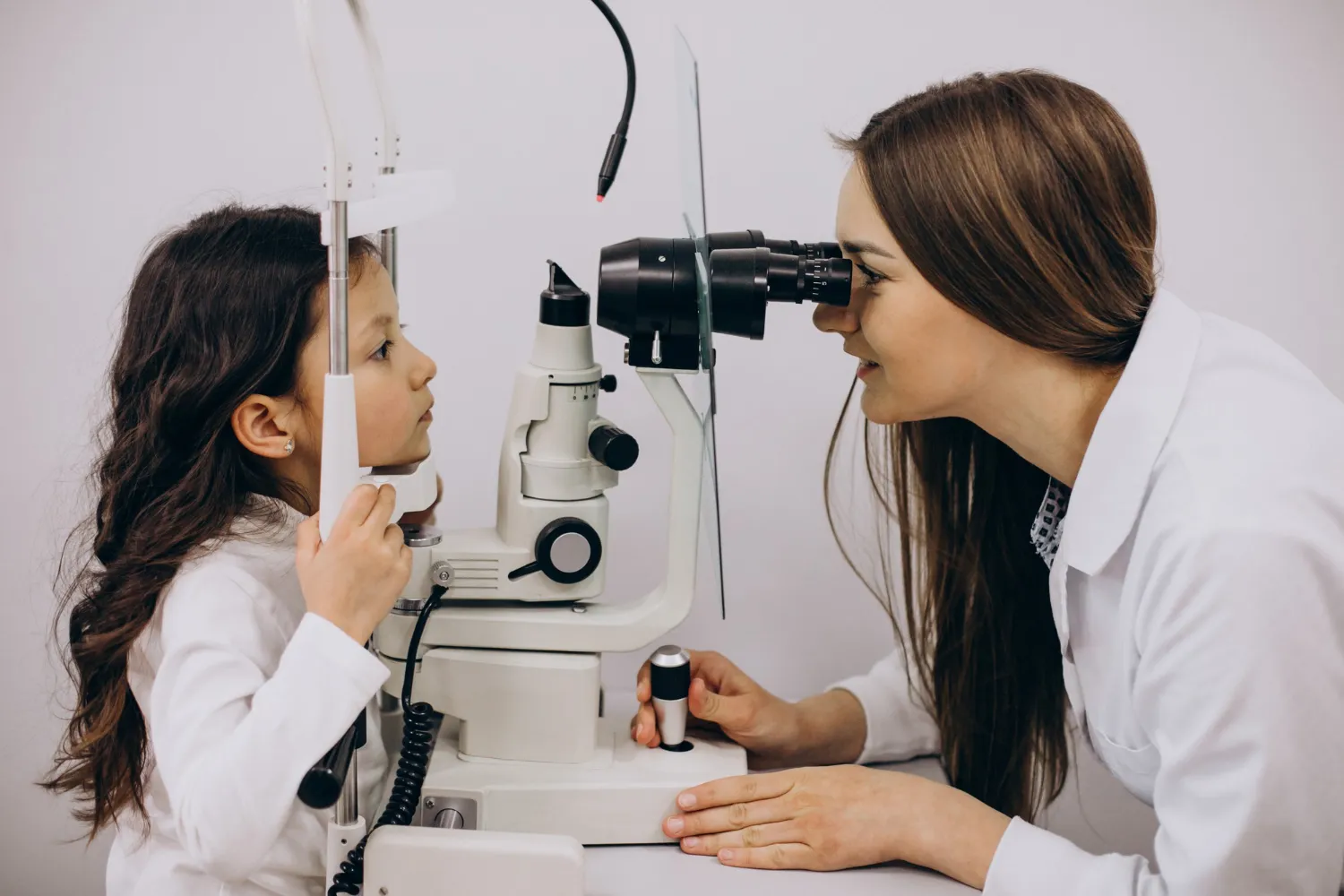
Specialised care for growing eyes
Children’s Eye Treatment
Paediatric ophthalmology addresses vision problems unique to children’s developing eyes. Early treatment during critical growth windows (birth-12 years) prevents permanent vision loss and supports learning, coordination, and confidence. Our approach combines gentle examinations, family education, and age-appropriate interventions.
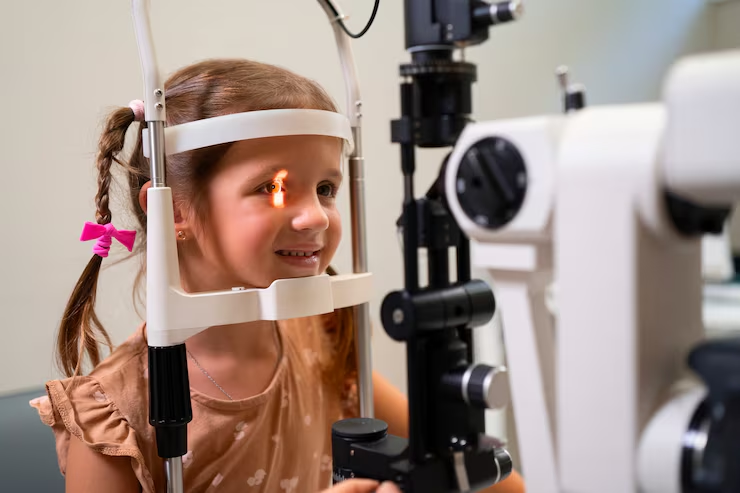
Early assessment supports healthy vision development
When to consider children’s eye evaluation
- Drooping eyelid covering part of the pupil
- Frequent eye rubbing, tearing, or light sensitivity
- Persistent redness, discharge, or eyelid swelling
- Inward- or outward-turning eyelids or lashes
- Abnormal head tilting or chin lifting to see
- Family history of childhood eye conditions
- Premature birth or developmental concerns
- Failed school or preschool vision screening
Children may not always express vision problems clearly. An eye assessment is recommended if you notice the following signs or risk factors:
What is involved in Children’s Eye Treatment?
Gentle care for developing vision
Children’s eye treatment begins with a careful, age-appropriate examination to assess vision, eyelid position, eye alignment, and overall eye health.
Depending on the condition, management may include observation, glasses, patching therapy, medicated drops, lid hygiene guidance, or minor surgical correction when necessary.
Care plans are tailored to support healthy visual development while ensuring comfort and safety at every stage.

Treatment options we may recommend
From glasses to gentle surgery
We provide a range of treatments for childhood eye conditions. Care plans are tailored to your child’s age, diagnosis, and stage of visual development.
Your Child’s Recovery
Supporting Clear Vision as They Grow
Most children adapt well to eye treatments. Recovery depends on the condition and type of treatment, and we will guide you at every step to ensure your child’s comfort and safety.
The Treatment
Glasses or patching may begin immediately, while procedures are carefully planned for the child, with parents receiving clear aftercare instructions.
The Next Few Days
Mild discomfort or adjustment is common, but most children return to school and daily activities quickly, with follow-up visits to monitor progress.
Ongoing Care
Vision development is monitored as your child grows, with treatment adjusted as needed and regular eye examinations supporting long-term eye health.
Patient voices
4.9 Stars on Google.
Real stories from the thousands of patients who have trusted us with their sight.
“Dr Huang literally saved my eyesight. After 3 doctors misdiagnosed my severe eye infection in Bali and things were getting worse, I booked a flight to Singapore and set an appointment with Dr Huang. Within 5 minutes of sitting down, he already correctly diagnosed my rare condition and began laying out my treatment plan.”

“One of the best decisions I’ve made! Dr Phi answered all my doubts and worries, and made sure that I’m assured on the procedure process and kindly explain to me every step that is he doing during the procedure itself, which is something I’m so appreciative for!”

“I’d like to thank Dr. Huang for being such a wonderful doctor through my process of getting perfect vision. He was so assuring and put me at ease throughout every step of the way, and conducted my procedure with utmost professionalism and expertise. Post-surgery care was also very well conducted; any concerns I had were addressed and allayed. Thank you so much for the great experience amidst what was initially a scary thing for me.”

I recently had TransPRK procedure done by Dr. Philemon and couldn’t have asked for a better experience. From the very first consultation, he took the time to explain every step in detail, making sure I understood what to expect. He’s very thorough and meticulous. You can tell he cares about his patients and takes pride in doing everything perfectly.
What stood out most was how genuine and attentive he is. He checked in with me before and after the procedure, made sure all my questions were answered, and went above and beyond to make sure I felt cared for.
It’s rare to find someone who’s both exceptionally professional and sincerely compassionate. I sincerely recommend Dr. Philemon to anyone considering refractive surgery.

I’m incredibly grateful to Dr Philemon Huang for the outstanding care and results he delivered. I underwent IOL implant surgery with Dr Huang, and it completely transformed my vision—from being unable to see without glasses to achieving 20/20 vision after surgery.
Dr Huang was clear, professional, and thorough in his recommendations, explaining why LASIK wasn’t suitable for me and why the IOL approach was the best option. His expertise and confidence made the entire process feel reassuring, and the results speak for themselves.
Thank you, Dr Philemon Huang, for your exceptional skill and care. I couldn’t be happier with the outcome.

Clarifying Your Concerns
Frequently Asked Questions
We understand that eye related conditions can feel overwhelming and daunting. Here are honest, transparent answers to the questions we hear most often from patients and their families
Common conditions include myopia (short-sightedness), squint (strabismus), amblyopia (lazy eye), allergic conjunctivitis, and eyelid conditions such as ptosis or chalazion.
While basic screenings happen in school, a comprehensive exam by a specialist is recommended at age 3, or earlier if you notice eye rubbing, tilting of the head, or squinting. Early detection of Amblyopia (Lazy Eye) before age 7 is critical, as treatment is much more effective while the brain’s visual pathways are still developing.
Myopia may be managed with spectacles and, in suitable cases, myopia control options such as atropine eye drops or specialised lenses. Regular monitoring is important.
Amblyopia occurs when one eye develops weaker vision. Treatment may include patching the stronger eye, prescription glasses, or medicated drops to encourage visual development.
Not always. Some cases can be managed with glasses or patching. Surgery may be considered if alignment does not improve with non-surgical treatment.
When prescribed and monitored by an ophthalmologist, medicated eye drops such as low-dose atropine are generally safe and commonly used for specific conditions.
Some mild conditions may improve with age, but others—such as myopia—often progress during school years and require monitoring.
Seek prompt assessment if your child has persistent eye redness, pain, sudden vision changes, white reflex in photographs, frequent squinting, or abnormal head posture.