
Use Your Child’s CDA for Eligible Eye Care Services
Child Development Account (CDA) / Baby Bonus Scheme
OneVision Eye Specialist & LASIK Centre is an Approved Institution registered with the Ministry of Social and Family Development (MSF) under the Baby Bonus Scheme.
Parents may use available funds from their child’s Child Development Account (CDA) to pay for eligible paediatric eye care services, subject to the prevailing Baby Bonus Scheme guidelines and available CDA balance.
What is the Child Development Account (CDA)?
The Child Development Account (CDA) is part of Singapore’s Baby Bonus Scheme. It is a special savings account that helps families pay for approved child-related expenses, including healthcare services at MSF Approved Institutions.
The Government provides:
- A First Step Grant when the CDA is opened
- Dollar-for-dollar matching of parents’ savings, up to the applicable cap
These funds can be used for eligible healthcare services until the child reaches the applicable age under the scheme.
CDA benefits available under the Baby Bonus Scheme
Child Development Account (CDA)
Amount
Notes
CDA First Step Grant
S$5,000
(1st & 2nd child)
(1st & 2nd child)
Automatically credited once the CDA is opened. No parental contribution required.
S$10,000
(3rd child onwards)
(3rd child onwards)
For eligible children born on or after 18 Feb 2025. Enhanced under the Large Families Scheme.
Government Co-matching
Dollar-for-dollar
Parents' deposits are matched up to the applicable cap.
Government co-matching caps
CDA Government Contribution by Birth Order
Birth order
First Step Grant
Government Co-matching
Total Government CDA contribution
1st child
S$5,000
S$4,000
S$9,000
2nd child
S$5,000
S$7,000
S$12,000
3rd & 4th child
S$10,000*
S$9,000
S$19,000
5th & subsequent
S$10,000*
S$15,000
S$25,000
*For eligible third and subsequent Singapore citizen children born on or after 18 February 2025.
Eligible Services
Depending on your child’s clinical needs and the prevailing MSF guidelines, CDA funds may generally be used for eligible paediatric ophthalmology services, including:
- Specialist eye consultations
- Comprehensive children’s eye examinations
- Assessment of refractive errors (myopia, hyperopia and astigmatism)
- Assessment and management of lazy eye (amblyopia)
- Assessment and management of squint (strabismus)
- Evaluation of congenital eye conditions
- Investigations and treatments that are eligible under the Baby Bonus Scheme
How Do I Use My Child’s CDA?
Using your child’s CDA at OneVision is straightforward.
- Inform our staff that you wish to use your child’s CDA.
- Present the necessary identification or payment authorisation.
- Our team will advise whether the services are eligible under the Baby Bonus Scheme.
- Payment will be deducted from your child’s available CDA balance where applicable.
If you have any questions before your appointment, our staff will be happy to assist.
When Should Your Child Have an Eye Examination?
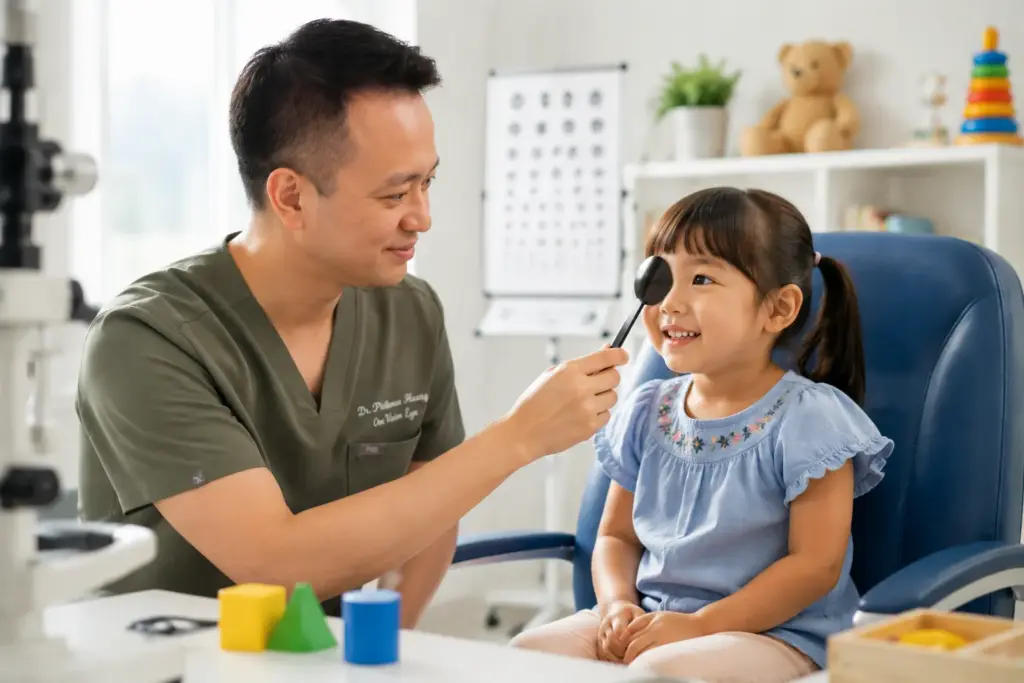
Children often do not realise their vision is blurred and may not tell you when something is wrong. In this short video, Dr Philemon Huang explains when a paediatric eye examination is recommended, the signs parents should look out for, and how early detection can support healthy visual development.
Common Questions
Children's Eye Health, Explained
A clear vision check-up matters more than you might think. Here's what parents most often ask us about children's eye examinations and screen time.
School screening is an important public health measure but is not a comprehensive eye examination. Some eye conditions affecting eye alignment, focusing, depth perception, or eye health may not be identified through routine screening alone.
Not always. Children often adapt remarkably well to reduced vision and may not recognise that anything is wrong.
Extended near work and limited outdoor time have been associated with a higher likelihood of developing myopia. Parents should encourage regular outdoor activities, appropriate screen breaks, and periodic eye examinations.
Yes. Children's eye examinations are non-invasive and are tailored to the child's developmental stage. Dilating eye drops may occasionally be used when clinically necessary to allow a more accurate assessment.
We are happy to answer your questions
Feel free to chat with us if you have more questions to ask us personally.
CONTACT US